E-invoices in a PDF:
ZUGFeRD and Factur-X.
An e-invoice in the ZUGFeRD or Factur-X format is a PDF that people read, with the same invoice inside it as XML that accounting software reads. SelectPdf PDF Editor shows the data of the e-invoices you receive, and attaches the XML your invoicing software makes to the PDF of the invoice, the way the standard requires.
See what an e-invoice really says.
Open a PDF that carries an e-invoice, and a notice above the pages names the standard and the profile, the invoice number, who issued it to whom, and the amount due.
Details lists what a person checks before paying: the dates, the seller and its VAT ID, the buyer's reference, the totals and the number of lines. It also says whether the document declares the invoice in its metadata, as the standard requires. View XML shows the invoice's XML laid out to be read, and Save XML saves it for your accounting software.
Compare the details with the pages: in Germany, the XML is now the part that counts. Free.
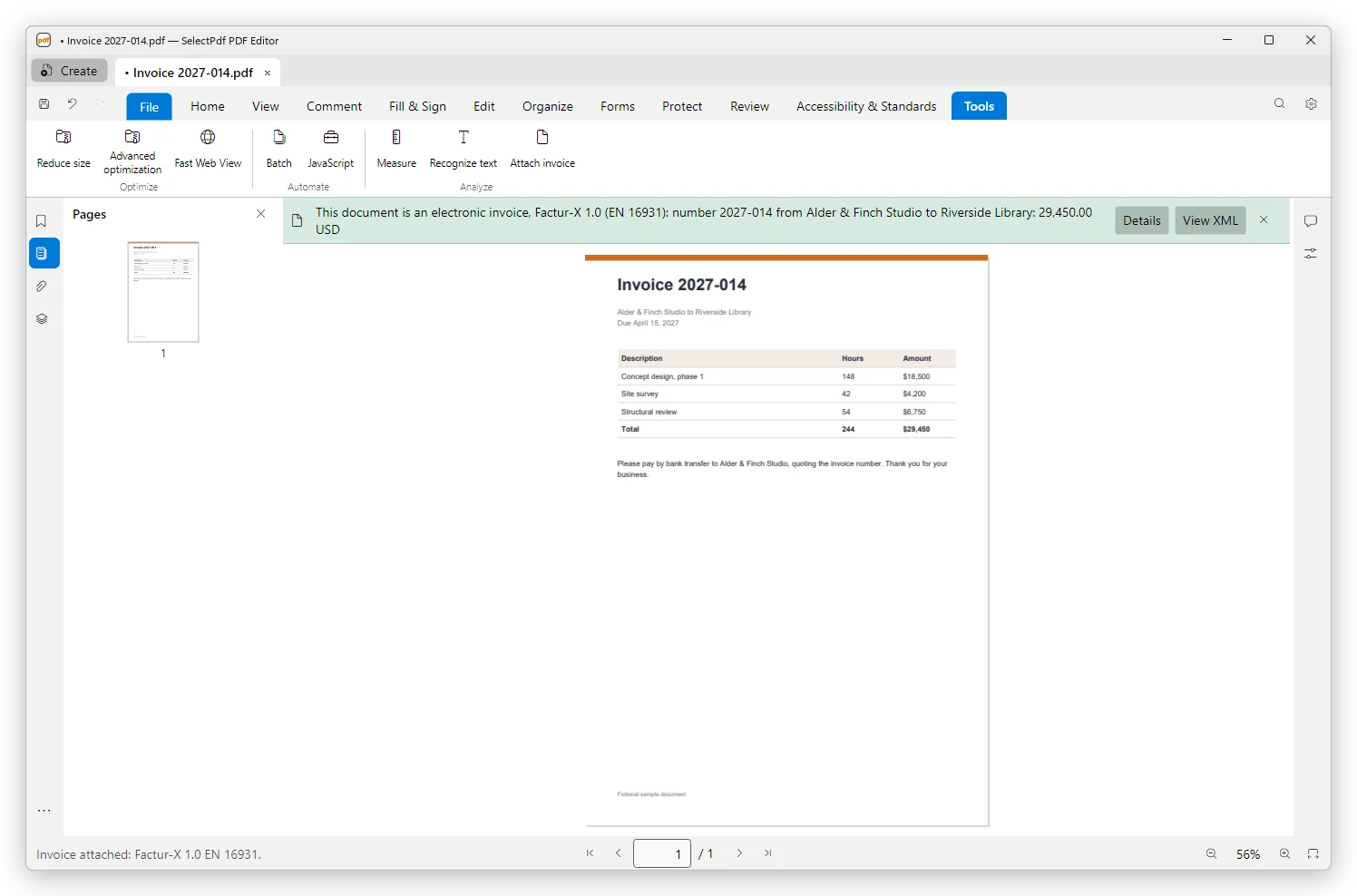
The invoice's data, at a glance.
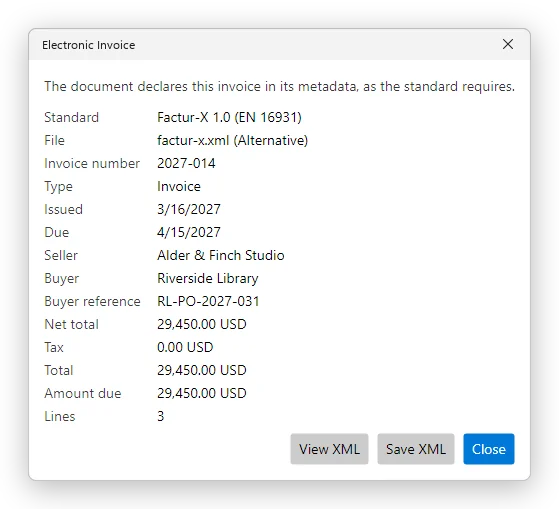
The standard and its profile, the file name of the XML, the invoice number and type, the dates it was issued and is due, the seller and the buyer, the totals in the invoice's currency, and how many lines it has. Only the details the invoice gives are listed.
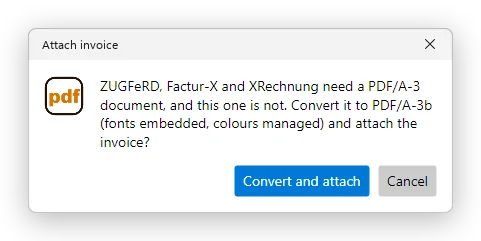
Attach the XML, as PDF/A-3.
Open the PDF your invoicing software printed, click Attach invoice and choose its XML. These standards need a PDF/A-3 document: when the PDF is not one, the editor converts it to PDF/A-3b, with its fonts embedded and its colours managed.
The XML is embedded under the name its standard requires and declared in the metadata. Attaching is one step that Undo takes back. Pro.
- ZUGFeRD and Factur-X, with the profiles MINIMUM, BASIC WL, BASIC, EN 16931 and EXTENDED
- XRechnung, the German public sector's invoice
- UBL invoices, such as Peppol BIS invoices, when they are in a PDF
- One invoice per document: a new one replaces the one it carries
Where e-invoicing stands.
- Germany: businesses must be able to receive e-invoices since 1 January 2025. Other invoices may still be issued until the end of 2026, or the end of 2027 with a prior-year turnover up to €800,000. ZUGFeRD counts from version 2.0.1, but not its MINIMUM and BASIC WL profiles.
- France: since 1 September 2026, every business receives e-invoices, and large and mid-size businesses issue them; small and micro businesses issue them from 1 September 2027. Invoices travel through a state-approved platform, and Factur-X is one of the accepted formats.
- Belgium: since 1 January 2026, invoices between Belgian businesses are structured e-invoices sent over Peppol; a PDF alone is not one.
The rules are the tax authorities': check them with your accountant, or on the pages of Germany's Federal Ministry of Finance, France's economie.gouv.fr and impots.gouv.fr, and Belgium's einvoice.belgium.be.
What it leaves to others.
The XML comes from your invoicing or accounting software: the editor does not write it, and does not check its content against the EN 16931 rules. It does not send invoices through Peppol or a French approved platform. It reads an invoice inside a PDF, not an XML file on its own. A signed document cannot have an invoice attached: attach it before you sign.
Seeing an e-invoice's data and saving its XML are free; attaching an invoice needs Pro, on Windows and Mac. See pricing →
E-invoices, answered.
Step by step: electronic invoices in the user guide.