PDF standards: PDF/A, PDF/UA and PDF/X
Check a PDF against PDF/A, PDF/UA or PDF/X with Verify Compliance, read what the check reports, fix what fails, save a report, and save a copy of a document as PDF/A for archiving.
Some PDF files must follow a standard, an ISO specification that says what the file may and must contain:
- PDF/A for documents kept for many years: archives, courts and public offices often ask for it;
- PDF/UA for documents everyone can read, including people who use a screen reader;
- PDF/X for documents sent to a printer.
The editor checks a document against any of them, fixes what it can, and saves a PDF/A copy of a document. The tools are on the Accessibility & Standards tab.

- Verify Compliance checks the document against a standard, in the Standards panel.
- Save as PDF/A saves a copy of the document as PDF/A.
Verifying a document and saving the report are free. Fix in the Standards panel, Fix… on a failure, and Save as PDF/A need Pro.
Verify a document
- Open the document and click Verify Compliance on the Accessibility & Standards tab. The Standards panel opens on the left.
- Choose the Standard. If the document says it meets a standard, that one is chosen already and marked (claimed). A document can claim a standard it does not meet: verify it to be sure.
- Click Verify.
The standards you can verify against are:
| Family | Standards |
|---|---|
| PDF/A | PDF/A-1a, PDF/A-1b, PDF/A-2a, PDF/A-2b, PDF/A-2u, PDF/A-3a, PDF/A-3b, PDF/A-3u, PDF/A-4, PDF/A-4e, PDF/A-4f |
| PDF/UA | PDF/UA-1, PDF/UA-2 |
| PDF/X | PDF/X-1a:2001, PDF/X-1a:2003, PDF/X-3:2002, PDF/X-3:2003, PDF/X-4 |
Read the result
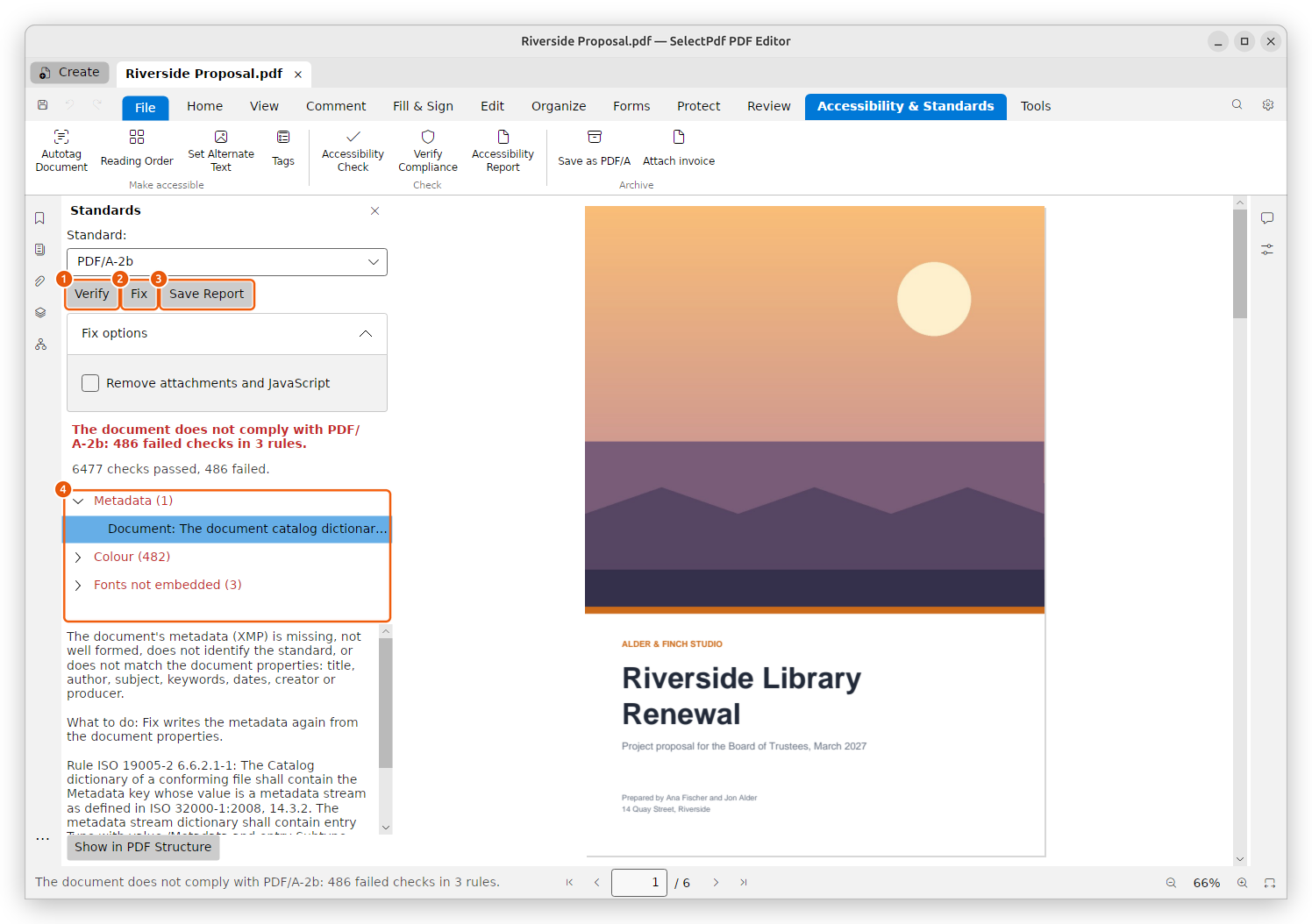
- Verify: check the document again, for example after a change.
- Fix: repair what can be repaired for the chosen standard.
- Save Report: save the result as a web page.
- What the document fails, grouped by what is wrong.
At the top, the panel says whether the document complies, in green, or how many checks failed in how many rules, in red, followed by how many checks passed and failed in all. A check that could not run to the end is never shown as compliant.
What fails is grouped by what is wrong, in plain words, such as Fonts not embedded, Transparency or Figure descriptions, with how many times it failed. Click the arrow before a group to see each failure, with where it is: Document, or a page number.
- Select a group or a failure to read below the list what it means and What to do: whether Fix repairs it, which of the Fix options does, which tool on the failure does, or why it cannot be fixed. Below that is the rule as the standard words it, with its clause (for example ISO 19005-2 6.2.11.4.1 for PDF/A-2) and, for a failure, what was found.
- To see what a failure names in the file, select it and click Show in PDF Structure below the list, or right-click it. PDF Structure opens with the operator selected in its content stream, or the object, or the page.
- Select a failure on a page to see that place on the page.
Fix what fails
Fix in one step
Fix repairs, in one step, what the editor can repair for the chosen standard, then verifies the document again and shows what is left: each failure that remains says that Fix did not repair it, and what to do instead. For PDF/A it converts the document to the chosen level; for the levels ending in a it tags a document that has no tags first. For PDF/A and PDF/X, a password-protected document loses its password, as these standards do not allow encryption.
Before you click Fix, open Fix options. They depend on the standard:
- PDF/A: Remove attachments and JavaScript removes the attached files the level does not allow, and the scripts.
- PDF/UA: Document language, the language set for the document when it has none, as a language tag such as en-US.
- PDF/X: the Output profile, the ICC profile of the printing condition (CMYK for PDF/X-1a): click Choose… and pick PSO Coated v3 (FOGRA51) or PSO Uncoated v3 (FOGRA52), the European Color Initiative's profiles for offset printing on coated and uncoated paper, or From a file… for your printer's .icc file. A PSO profile is downloaded the first time you pick it (about 2 MB), then kept. Clear uses a registered printing condition instead. PDF/X-4 needs a profile: ask your printer which one they print to. Remove annotations from the printed area draws what comments and fields print into the page and removes them; a highlight or a see-through box looks as it did, over the text and the page's background, without the transparency PDF/X-1a and PDF/X-3 forbid. PDF/X-4 keeps it as it is. Remove attachments and JavaScript removes them.
Fix is one step that Undo (Ctrl+Z) takes back. Save the document to keep it, or use Save As to keep the original as it was.
Fix one failure
Many PDF/UA failures have a fix of their own. Select the failure and click Fix… below the list, or double-click it:
- a figure without alternate text opens Set Alternate Text on that figure;
- a table whose rows have different numbers of cells opens the Table Editor of the Reading Order tool on that table;
- a form field without a description opens the field's properties;
- a missing document language or title asks for it;
- untagged content, table cells and rows or list items in the wrong place, header cells without a scope, headings that skip a level, comments and links without tags or descriptions, and the tab order are repaired as the Accessibility Checker repairs them.
After the fix, the document is verified again. Other failures have no fix of their own: fix them with Fix, or by hand, as What to do says. To fix tags and the reading order by hand, see Tags and reading order.
Save a report
Click Save Report and choose where to save it. The report is a web page you can open in any browser or send to others: the document, the standard, the result, the date of the check, and each failed rule with its failures and where they are.
Save as PDF/A
Save as PDF/A saves a copy of the document that conforms to PDF/A: the fonts are embedded, the colours are defined, and nothing depends on anything outside the file. The open document does not change.
- Click Save as PDF/A on the Accessibility & Standards tab, or click File, then Export, then Save as PDF/A.
- Choose the level. PDF/A-2b is chosen already: it suits most documents.
- Click Save and choose where to save the copy. The name proposed is the document's, with the level, such as Riverside Proposal (PDFA-2b).pdf.
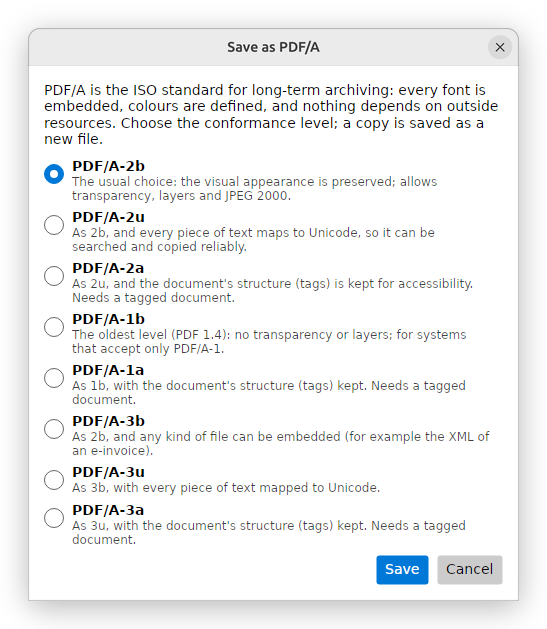
| Level | Choose it when |
|---|---|
| PDF/A-2b | You need PDF/A and nothing more: the pages look the same for years. |
| PDF/A-2u | The text must also be searched and copied reliably. |
| PDF/A-2a | The document must also stay accessible: its tags are kept. |
| PDF/A-1b, PDF/A-1a | The archive accepts only PDF/A-1. PDF/A-1 does not allow transparency or layers. |
| PDF/A-3b, PDF/A-3u, PDF/A-3a | Files of any kind must be attached, such as the XML of an electronic invoice. |
The levels ending in a need a tagged document: for a document without tags, the dialog says so and they cannot be chosen. Tag it first; see Accessibility.
The copy opens in a tab of its own, and the editor verifies it against the level you chose. The message at the top of the window and the status bar say whether it complies; if it does not, the Standards panel opens with what failed.
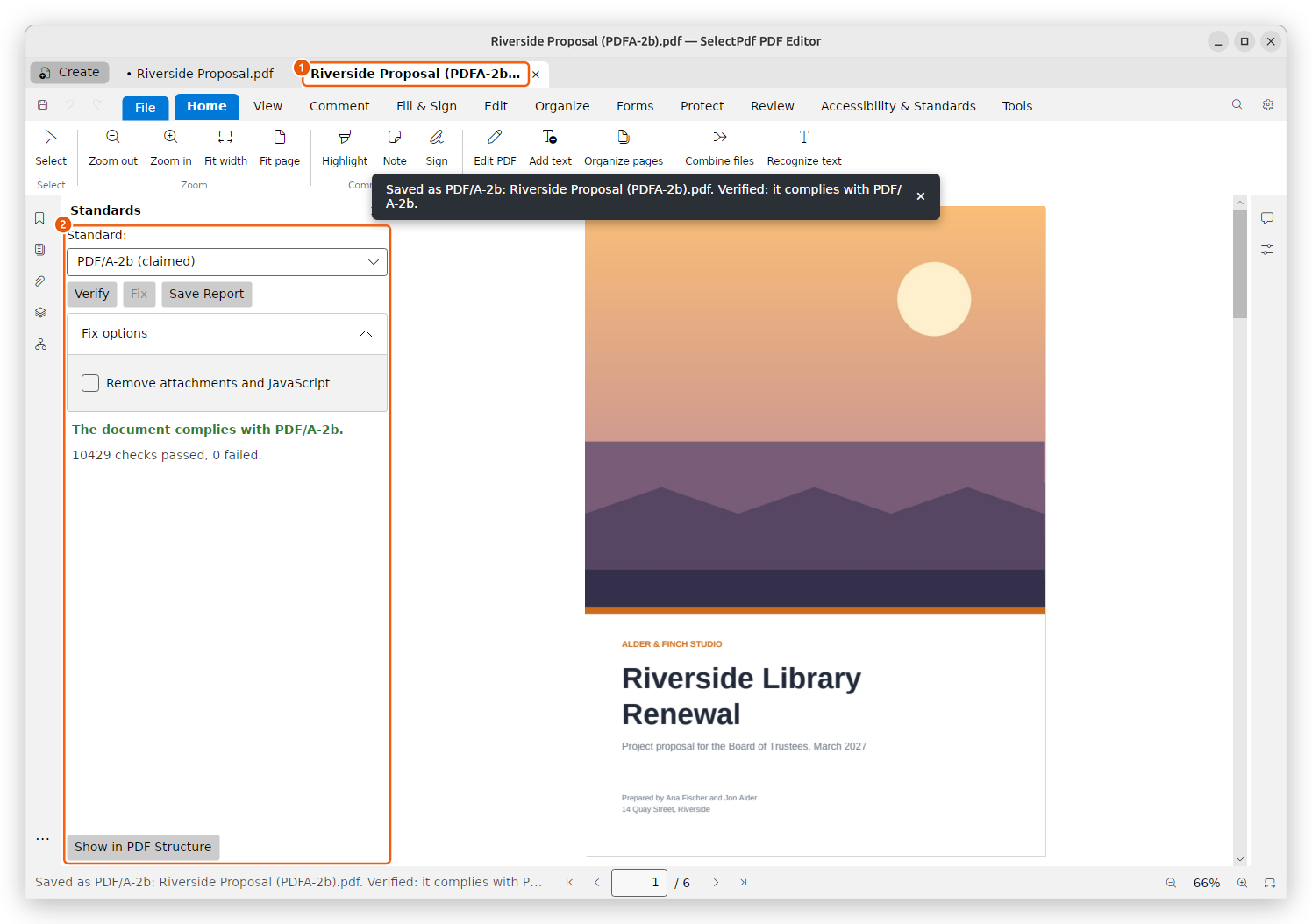
- The copy, in a tab of its own.
- The Standards panel: the copy claims PDF/A-2b and complies with it.
A signed document cannot be saved as PDF/A: converting it would rewrite it and break its signatures. Save as PDF/A before you sign. A password-protected document cannot either, as PDF/A forbids encryption: remove its security first.
To check a document against PDF/A-4, or against a PDF/A level without converting it, use Verify Compliance.